Complex and Contentious
Resolving Conflict at the Intersection of Science and Faith

There’s been a lot of discussion lately about artificial intelligence. Many individualsl are unsure whether they should be using it. I have been using A.I. [in my case, Google Gemini] when I have a question that has a factual answer. I’ll give you an example. When I have a problem with computer software not working as it should or not knowing how to do something, I just ask Google Gemini how it’s to be done and almost immediately I have the answer I need. No looking all over the internet. No manuals. No userguides. Just the answer I need, succinctly explained. I have subsequently discovered that Google Gemini has an amazing ability to summarize documents. This Substack post features a Google Gemini summary of the introduction of my book Evolving Certainties: Resolving Conflict at the Intersection of Faith and Science.
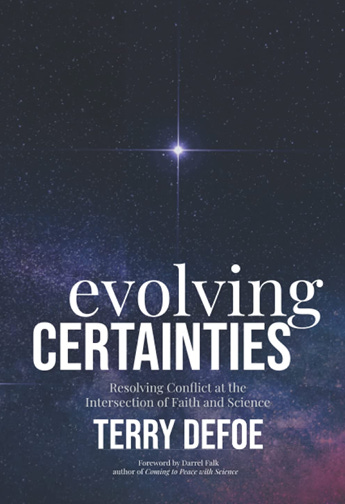
Summary of Chapter 1: Introduction – Evolving Certainties
The Evangelical Dilemma
Chapter 1 introduces the complex and often contentious relationship between evangelical Christianity and the theory of evolution. For many evangelicals, the Genesis creation accounts are not merely ancient stories but the foundation for the entire Gospel message. The author notes that a specific interpretation of these accounts is often tied directly to a believer’s view of biblical inspiration, inerrancy, and the overall authority of God’s Word.
The core of the tension lies in the perceived conflict between the “Book of God’s Word” (the Bible) and the “Book of God’s Works” (nature). While many feel forced to choose one over the other, the author argues—following the logic of Francis Bacon—that these two “books” cannot ultimately contradict each other because they share the same author.
The Role of “Ancient Science” in Scripture
A central theme of the introduction is the recognition that the Bible contains “ancient science.” The author posits that the biblical writers utilized the common-sense, pre-scientific understanding of their time to communicate spiritual truths.
Inaccuracy vs. Intent: From a modern perspective, this ancient science (such as a flat earth or a solid dome sky) is inaccurate. However, the author argues that these descriptions were never intended to be modern scientific statements.
The Benefit of Science: Rather than being an enemy to faith, modern science can actually help Christians understand the Bible better by clarifying which parts of the text are culturally conditioned “ancient science” and which parts are timeless spiritual revelations.
The Author’s Personal Journey
The author frames the book as an “intellectual journey” similar to traveling to a foreign country. Writing as an “interested layperson” and a retired pastor rather than a scientist, the author describes a personal paradigm shift: moving from a Young-Earth Creationist model to an Evolutionary point of view. This shift is not described as a loss of faith, but as a “refinement of certainties.” The author acknowledges that many contemporary Christians feel like they are in a “strange new land” when dealing with science and hopes to provide a map for navigating that territory.
Methodology: Information over Persuasion
The introduction establishes the tone for the rest of the book:
Goal: The aim is to inform and provide a broad overview of different positions (Atheistic, Young-Earth, Old-Earth, Evolutionary Creation, and Intelligent Design) rather than to aggressively persuade the reader to adopt a single view.
Respectful Dialogue: The author emphasizes that more is accomplished through respectful conversation than through negative attacks.
Critical Thinking: Following the advice of Thomas Henry Huxley, the author encourages readers to hold their ideas “up to the light of truth” to see what they are made of.
Conclusion
The introduction concludes by warning that no one should discard a deeply held belief system without careful thought and sufficient information. The book serves as a resource for those who are “searching for a way to maintain their faith while living in a scientifically-advanced world”.