A Dangerous Idea
Darwin's theory continues to cause serious cognitive dissonance for many.

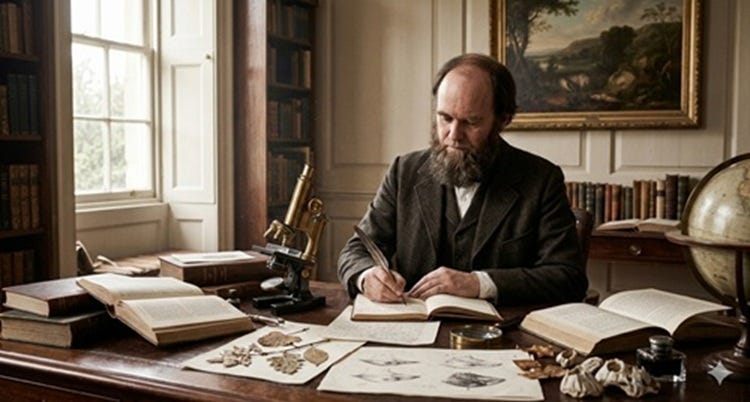
A Summary of Chapter Five of Terry Defoe’s Evolving Certainties: Resolving Conflict at the Intersection of Faith and Science titled The Biological Revolution.
ABSTRACT
Darwin waited a full twenty years before publishing his thoughts, knowing full well that his theory would cause a storm of controversy. He publicly revealed his views when he could conceal them no longer. Darwin wanted to be prepared to respond to the arguments he knew would be raised. He was well aware that his theory especially his views on human origins would not sit well with many people of faith. The idea that humans are descended from beasts has always been the most troubling aspect of Darwin’s theory for believers. There remains a major reason why his theory is rejected even today. No other theory has had such a huge huge impact on the understanding of humanity’s meaning and purpose.
I. The Life and Intellectual Journey of Charles Darwin
Charles Darwin was born on February 12, 1809, into an upper-middle-class family. Though his father, Dr. Robert Darwin, pressured him to study medicine at the University of Edinburgh, Darwin proved ill-suited for the profession and dropped out after two years. He subsequently studied theology at Cambridge, but his true lifelong passion was the pursuit of scientific knowledge, particularly geology.
Darwin’s scientific vocation was solidified during a transformative five-year voyage (1831–1836) aboard the HMS Beagle. Serving as the ship’s naturalist, he collected 5,000 specimens and compiled 2,000 pages of notes, despite enduring chronic seasickness and a clashing relationship with the authoritarian Captain Robert Fitzroy. This journey provided the meticulous observations that became the foundation of his theory.
Darwin was influenced by several key figures and ideas:
Geology: Charles Lyell introduced Darwin to uniformitarianism, a perspective Darwin credited with half the contents of his own books.
Population Dynamics: Reading Thomas Malthus’s work on population growth competing for limited food supplies was a major turning point in his thinking.
Existing Evolutionary Ideas: Ideas of “transmutation of species” were already circulating, including through his grandfather Erasmus Darwin and Robert Chambers’ sensational book, Vestiges of the Natural History of Creation.
II. The Theory of Evolution by Natural Selection
Darwin’s magnum opus, On the Origin of Species, was published in 1859. He had kept his theory a secret for twenty years, fearing the controversy it would cause regarding human origins. He was spurred to publish when Alfred Russell Wallace independently discovered the same mechanism for evolution in 1858.
Key Mechanisms of Evolution
Natural Selection: Darwin compared “artificial selection” by breeders to nature’s process, where environmental pressures select individuals with traits better equipped for survival.
Genetic Variation and Mutation: While Darwin knew nothing of modern genetics, he understood that variation was necessary. Modern science now identifies mutations (genetic copying errors) as the raw material for evolution.
Common Descent: Darwin proposed “descent with modification,” suggesting that all vertebrates share a unified architecture because they evolved from a common ancestor.
Complexity and Contingency
Evolution is an opportunistic “tinkering” process rather than a path toward perfection. It often involves exaptation, where existing structures are re-purposed for new functions. Furthermore, convergent evolution demonstrates that unrelated organisms can independently evolve similar solutions to environmental challenges, such as the eye developing multiple times in different lineages.
III. Evidence for Evolution: Consilience Across Disciplines
The strength of evolutionary theory lies in consilience—the drawing together of evidence from diverse fields.
The Fossil Record: Although Darwin worried about gaps in the record, modern paleontology has discovered numerous transitional forms. Notable examples include the evolution of whales and Tiktaalik roseae (the “fishapod”), which bridges the gap between fish and amphibians.
Molecular Biology and Evo-Devo: Modern genetics has revealed Hox genes, ancient “master planning” genes that control body plans across vastly different species. Evolutionary developmental biology (Evo-Devo) shows how small changes in these genes can lead to rapid morphological shifts.
Paleogenomics: Scientists can now sequence DNA from extinct organisms, such as hominins from 80,000 years ago, and extract proteins from fossils millions of years old.
IV. Darwin’s Personal Struggles and Legacy
Darwin was an introverted man who suffered from poor health for much of his life. His relationship with faith was complicated; though he studied theology as a young man, his faith faded toward agnosticism. This decline was accelerated by the death of his ten-year-old daughter, Annie, in 1851. Despite his personal religious shift, he remained a member of the Church of England and was buried with full honors in Westminster Abbey.
Modern Perspectives and Controversies
While the core of Darwin’s theory is widely accepted in the scientific community, debates continue regarding the details of the process.
Punctuated Equilibrium: Proposed by Stephen Jay Gould and Niles Eldredge, this model suggests evolution happens in “fits and starts” (stasis followed by rapid change) rather than constant gradualism.
Active Roles of Organisms: Recent findings suggest organisms may play a more active role in their own development and the direction of evolution than previously thought.
Ultimately, Darwin transformed biological science. His work provided a framework that has been consistently strengthened by subsequent discoveries in genetics, DNA, and the fossil record.